
The Sensible Desk: Light, Cables and a Clear Surface

Desk advice tends to arrive in two unhelpful flavours: the thousand-pound overhaul with the motorised desk and the monitor arm, or the aesthetic tour of someone's beige peripherals. This is neither. This is the buyer's version: the three problems that make a desk unpleasant to sit at — bad light, cable chaos and a colonised surface — and the cheapest honest fix for each. All of it fits in a weekend, and most of it fits in an afternoon.
Problem one: you are working in bad light
Most home desks are lit by a ceiling fixture somewhere behind the occupant, which means you spend the day working in your own shadow and blaming your eyes. The fix is task lighting: a lamp at the desk, aimed at the work, adjustable enough to move with the day.
Adjustable is the load-bearing word. Light that suits a bright morning is wrong for a dark 4pm in January, and the light you want for spreadsheets is not the light you want for reading at nine. This is why the Adjustable LED Desk Lamp runs three colour temperatures and five brightness levels rather than one heroic setting — cool and bright when you need to focus, warm and low when the day winds down. The folding arm matters more than it sounds, too: light aimed across the keyboard rather than down at the screen is the difference between task lighting and glare with a stand.
- Put the lamp on the opposite side to your writing hand, so your hand does not shadow the page.
- Aim the head at the desk surface, not the screen — screens light themselves.
- Match the lamp roughly to the room light in the evening; a bright lamp in a dark room is a fast route to eye strain.
- If the lamp has a USB port in the base, that is your phone's new home — one less charger on the desk, and the phone is face-down and slightly further away, which does no harm at all.
Problem two: the cable situation
Behind almost every home desk is a nest of cables that everyone has agreed not to look at. It is ugly, it is dusty, it eats plugs — somewhere in there is the adaptor you have been missing since March — and it makes cleaning the floor a negotiation. It is also the single most satisfying fix on this list, because the before-and-after is absolute.
- Unplug everything. Yes, everything. Ten minutes of inconvenience buys you a clean slate.
- Separate the cables you actually use from the ones that live there out of habit. The spares go in a labelled box, not back behind the desk.
- Bundle the permanent run — power strip, monitor, lamp — into a sleeve, and route it along the desk edge or wall with clips.
- Label both ends of anything you will ever unplug. Future you, under the desk with a torch, will be grateful.
- Leave one visible, easy-to-reach charging cable at desk level. That is the concession that stops the whole system unravelling.
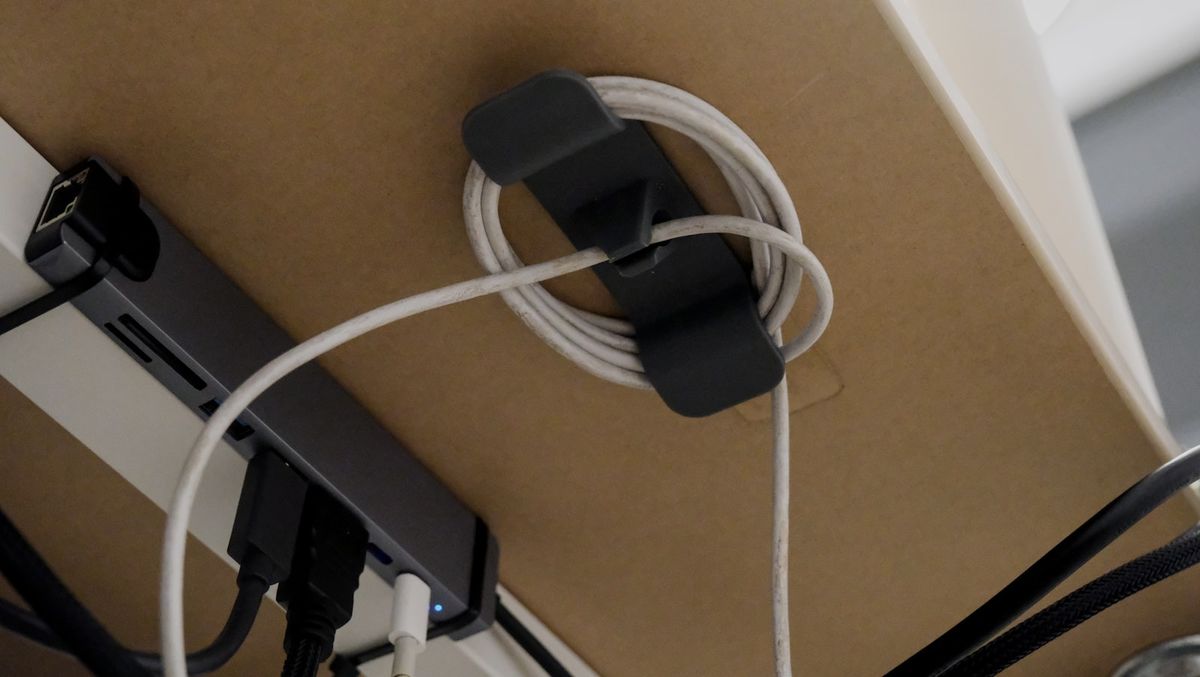
A Cable Tidy Kit covers the whole job in one box — sleeve, clips, ties and labels — and costs about as much as a takeaway. It is modest money for a disproportionate result, which is this shop's favourite ratio. The one piece of buying advice: make sure the adhesive is the kind that peels off clean. Renters should not have to choose between tidy cables and a deposit.
Problem three: the surface has been colonised
A desk surface obeys the same law as every flat surface in a small home: unclaimed space fills with objects. The mug graveyard, the paper drift, the charging museum. The cure is the same container logic Priya laid out for small-space storage — give every category one home, and give the desk itself a job description: things needed this week live here; everything else lives somewhere that is not the desk.
In practice that means one small tray or basket for the working clutter — notebook, pens, the current charging cable — and a hard rule that paper does not sleep on the desk. A two-minute sweep at the end of the day resets the surface, and a reset surface is half the reason people enjoy working at cafés: the table starts empty.
What you get for a weekend
Total damage for all three fixes is a lamp, a cable kit and a basket — less than a mid-range office chair, no furniture assembly, no drilling unless you want it. What you get back is a desk that is pleasant at 9am and still pleasant at 9pm, which no amount of beige peripherals can deliver on its own. Fix the light, hide the cables, defend the surface. Everything else is decoration.
Modest money for a disproportionate result — this shop's favourite ratio.
A short word on what deliberately did not make this list. Monitor arms, standing desks and ergonomic chairs are all real upgrades, and if you sit at a desk for eight hours a day and have the budget, a decent chair is probably the single best purchase you can make — but it is a considered, try-before-you-buy purchase, not a weekend fix, and no lamp can substitute for it. The point of this list is sequencing: sort the cheap, high-impact problems first, live with the result for a month, and then decide whether the expensive problems still feel like problems. They often do not.
And if the desk overhaul awakens the organising itch, the kitchen and the suitcase are the natural next stops. The principle travels: containers with one job, tools that adjust to the day, and a flat surface treated as territory to defend rather than storage to fill.
Found this useful? Pass it on.